

02 Oct Cuteness in persuasive communication encourages responsible behavior

Cute works! New research shows that cuteness in destination messaging catches visitors’ attention, and it can encourage environmentally responsible behavior.
Persuasive communication is one practical way destinations can encourage visitors to make more responsible choices. A study by Xu et al. (2025) examined how the design of sustainable tourism messages can influence tourists’ environmentally responsible behavioral intentions, focusing specifically on the persuasive power of cuteness.
The researchers looked at two routes to persuasion: central and peripheral. While the central route focuses on the message itself, the peripheral route relies on cues that can capture attention without being directly related to the message argument. And the latter might be a more effective design for communication to encourage responsible behavior.
The study examined two types of cuteness. Kindchenschema cuteness, which basically refers to using infant-like features (e.g., large, round eyes), and whimsical cuteness (e.g., playful or quirky elements).
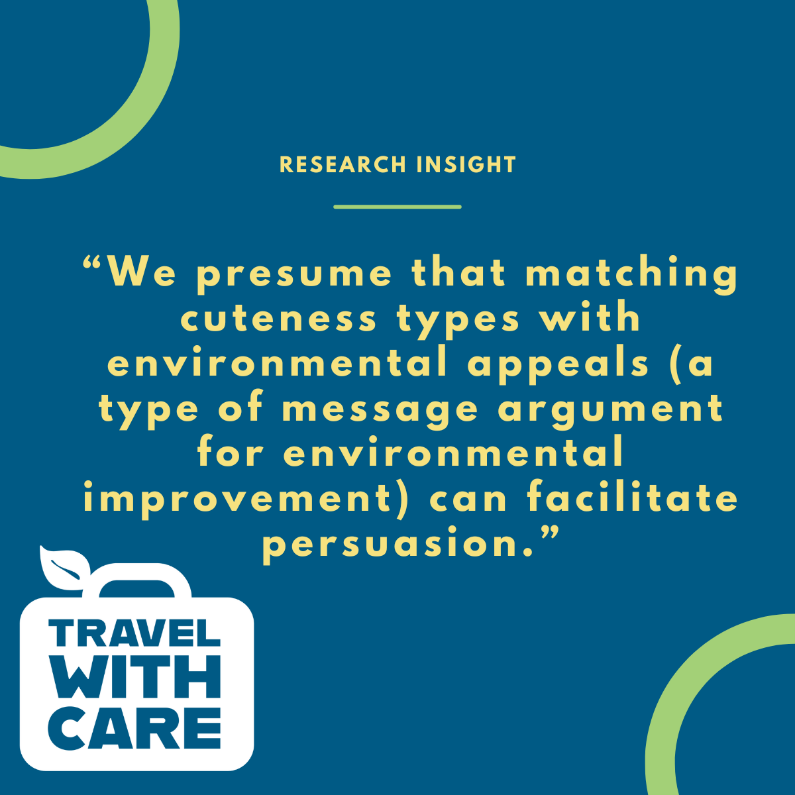
They argued that infant-like features in communication can encourage responsible behavior. However, the type of cuteness matters. When the cute design was congruent with the environmental appeal, it strengthened the persuasive effect.
The takeaway is not simply to make messages cute, but to match the design cue with what the destination is trying to communicate.
This study reinforced the need for DMOs to consider persuasive communications in their efforts for encouraging responsible behavior. Focusing on what works helps save resources and improve destination management by sending the right message that catches visitors’ attention.
For DMOs:
DMOs can match design with the message. Choose a type of cuteness that complements the environmental appeal rather than using playful elements simply for decoration. You can even use cuteness as a tool to improve impact.
Thoughtful design can help destinations capture attention, communicate the right message, and encourage visitors to make more responsible choices.
The study can be found here.
Xu, X., Wang, S., Liu, J., Wang, X. L., & Morgan, N. (2025). ‘How does the cuteness of persuasive communication about sustainable tourism shape tourists’ environmentally responsible behavioral intentions?’ Journal of Sustainable Tourism, 33(11), 2367–2395. doi:10.1080/09669582.2025.2478187
