19 Aug Banning Single Use Plastics

WHY BAN SINGLE USE PLASTICS
A destination-wide single-use plastic ban helps DMOs create a cleaner, greener, and more competitive destination that meets both traveler expectations and long-term sustainability goals1,2. Banning single-use plastics can reduce pollution in the natural environment and protect wildlife and ecosystems that are part of the destination’s appeal3–5. It demonstrates a commitment to sustainability, which increasingly appeals to conscious travelers6,7. This policy establishes clear expectations for visitors and helps to normalize low-waste behaviors by creating a consistent experience across the destination8,9. A policy like this can also encourage local entrepreneurs to develop or sell reusable alternatives, creating new business opportunities. On the larger scale, banning single-use plastics supports national and international commitments to reduce plastic waste, like the UN Sustainable Development Goals10,11.
WHAT IT MEANS TO BAN SINGLE USE PLASTICS
Banning single-use plastics means prohibiting the use, sale, or distribution of plastic items that are designed to be used once and then thrown away4,12,13. A ban typically applies across public and private sectors within a destination and may include plastic straws, stirrers, and cutlery, plastic grocery bags, foam takeout containers and plastic water bottles (in some cases) and more. A ban may be partial or phased (e.g., starting with government buildings or parks), or destination-wide including all tourism businesses.
This encourages tourism businesses to adapt. For example, hotels must switch to refillable toiletry dispensers or compostable alternatives, restaurants and cafes need to provide biodegradable or reusable containers, cups, and utensils, and tour operators may need to provide refillable water stations or encourage use of reusable bottles during tours. While the initial costs for biodegradable alternatives can be more expensive, over time, destinations can save money through reduced litter cleanup, fewer landfill costs, and healthier ecosystems1,14.
HOW TO DO IT
In the District of Tofino, British Columbia, Canada, polystyrene foam takeout containers, plastic straws, and checkout bags were initially banned by the municipality in 2020. In late 2023, the District launched a public consultation on the proposed prohibition of plastic water bottles under 1 litre. By April 2024, the Council formally approved a ban on these small plastic bottles, pending provincial approval. There are currently 13 public refill stations in place, with a 14th under construction, and 71 businesses have pledged not to sell plastic water bottles. This ban reduces pollution and marine debris and lowers municipal waste management and cleanup costs, freeing resources for other priorities. Tofino’s approach is a strong example of how coastal communities can protect fragile environments while fostering sustainable tourism.
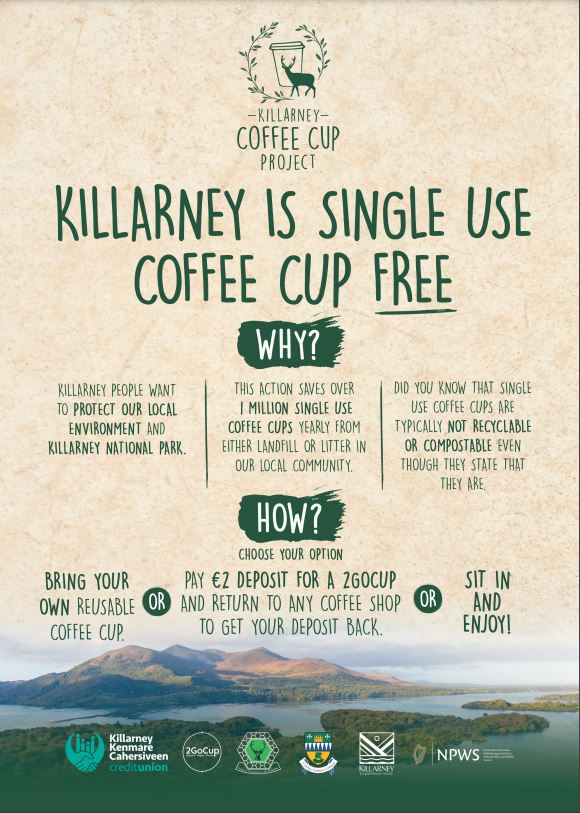
Killarney, Ireland was the first town to implement a town-wide initiative to eliminate single-use coffee cups. The Killarney Coffee Cup Project was first initially driven by volunteer clean‑ups that identified single-use coffee cups as a major litter problem, especially in the Killarney National Park. The goal was to target the removal of over 1 million cups per year, equivalent to 18.5 tonnes of waste. Starting July 2023, 25 independent cafés and 21 hotels committed to no longer offering single-use cups. Instead, visitors can bring their own reusable cup or enjoy coffee on-site. They can also pay a €2 deposit for a reusable cup (returnable at any participating location in Killarney and even up to 400 nationwide locations). The initiative effectively eliminated about 23,000 single-use cups per week, or over one million annually, dramatically reducing litter. Residents, tourists, and waste crews have all noted the sharp decrease in litter and the prevalence of reusable cups around town and in the National Park. The ripple effect has since spread to over 20 towns across Ireland who wished to replicate the project, inspired by Killarney’s success. Killarney’s community-led Coffee Cup Project showcases how local stakeholders can drive meaningful environmental impact through simple systems and strong collaboration.
DMOs mentioned
https://tofino.ca/
https://killarney.ie/
Other helpful materials
World Economic Forum. (2024). Creating a plastic-free tourism sector is a challenge. Here’s why it’s worth it.
https://www.weforum.org/stories/2024/10/tourism-travel-plastic-sustainability-challenges-solutions/
Sustainable Ocean Alliance. (2022). Plastic Free July: How 20 countries are taking action. https://www.soalliance.org/soablog/plastic-free-july-20-countries-taking-action
Sustainable Hospitality Alliance. (2021). Single-use Plastics. https://sustainablehospitalityalliance.org/wp-content/uploads/2021/06/Plastic-factsheet.pdf
World Travel & Tourism Council. (n.d.). Rethinking Single Use Plastic Products (SUPPs) in Travel & Tourism. https://wttc.org/sustainability/environment/plastic
Raab, K., Wagner, R., Ertz, M., & Salem, M. (2022). When marketing discourages consumption: demarketing of single-use plastics for city tourism in Ottawa, Canada. Journal of Ecotourism, 22(3), 375–405. https://doi.org/10.1080/14724049.2022.2028794
Guittard, A., Akinsete, E., Demian, E., Koundouri, P., Papadaki, L., & Tombrou, X. (2023). Tackling Single-Use-Plastic in small touristic islands to reduce marine litter: Co-identifying the best mix of policy interventions. Frontiers in Environmental Economics, 2. https://doi.org/10.3389/frevc.2023.1145640
Khasawneh, N., Bader, M., & Hasan, A, A. (2025). Strategies of reducing single-use plastics: a plastic-reducing behavior model (PRBM) predicting single-use plastic-reduction behaviors among coastal tourists. Journal of Hospitality and Tourism Insights. https://doi.org/10.1108/JHTI-09-2024-0970
References
1. Dev, S. (2024, October 17). The Impact of the Ban on Single-Use Plastics: A New Era for Sustainability. Dr. Sajeev Dev. https://sajeevdev.com/the-impact-of-the-ban-on-single-use-plastics-a-new-era-for-sustainability/
2. Sustainability Leaders United. (2019, October 23). How to Make Destinations More Sustainable: What DMOs Can Do Right Now | Sustainability Leaders United. https://sustainability-leaders.com/how-to-make-destinations-sustainable/
3. Turpie, J., Letley, G., Ng’oma, Y., & Moore, K. (2019). The Case for Banning Single-use Plastic products in Malawi (No. AEC/1836/1; Anchor Environmental Consultants Report, p. 57). Report prepared for UNDP on behalf of the Government of Malawi by Anchor Environmental Consultants in collaboration with Lilongwe Wildlife Trust. https://anchorenvironmental.co.za/sites/default/files/2019-04/Addressing%20plastic%20pollution%20in%20Malawi%20-%20Final%20report.pdf
4. The Editors of ProCon. (2025, July 16). Single-Use Plastics | Pros, Cons, Debate, Arguments, Plastics Bans, & Examples | Britannica. https://www.britannica.com/procon/single-use-plastics-debate
5. World Wildlife Fund. (2024, April 11). 85% of People Want Global Ban on Single-Use Plastics. World Wildlife Fund. https://www.worldwildlife.org/press-releases/85-of-people-want-global-ban-on-single-use-plastics
6. Raab, K., Wagner, R., Ertz, M., & Salem, M. (2023). When marketing discourages consumption: Demarketing of single-use plastics for city tourism in Ottawa, Canada. Journal of Ecotourism, 22(3), 375–405. https://doi.org/10.1080/14724049.2022.2028794
7. Adam, I. (2023). Rational and Moral Antecedents of Tourists’ Intention to Use Reusable Alternatives to Single-Use Plastics. Journal of Travel Research, 62(5), 949–968. https://doi.org/10.1177/00472875221105860
8. Zahrah, Y., Yu, J., & Liu, X. (2024). How Indonesia’s Cities Are Grappling with Plastic Waste: An Integrated Approach towards Sustainable Plastic Waste Management. Sustainability, 16(10), 3921. https://doi.org/10.3390/su16103921
9. Guittard, A., Akinsete, E., Demian, E., Koundouri, P., Papadaki, L., & Tombrou, X. (2023). Tackling Single-Use-Plastic in small touristic islands to reduce marine litter: Co-identifying the best mix of policy interventions. Frontiers in Environmental Economics, 2. https://doi.org/10.3389/frevc.2023.1145640
10. Abril Ortiz, A., Sucozhañay, D., Vanegas, P., & Martínez-Moscoso, A. (2020). A Regional Response to a Global Problem: Single Use Plastics Regulation in the Countries of the Pacific Alliance. Sustainability, 12(19), 8093. https://doi.org/10.3390/su12198093
11. Walker, T. R. (2021). (Micro)plastics and the UN Sustainable Development Goals. Current Opinion in Green and Sustainable Chemistry, 30, 100497. https://doi.org/10.1016/j.cogsc.2021.100497
12. Kolcon, M. (2021). Plastic Prohibition: The Case For A National Single-Use Plastic Ban In The United States. PENN. ST. J.L. & INT’L AFF., 194. https://insight.dickinsonlaw.psu.edu/jlia/vol9/iss2/9
13. Vermillion, S. (2024, April 16). What Are Single-use Plastics and Should They Be Banned? HowStuffWorks. https://science.howstuffworks.com/environmental/conservation/issues/single-use-plastics.htm
14. Goodrum, R., Bartokova, B., & Roy, P. (2024). Life Cycle Assessment of Banned Single-Use Plastic Products and Their Alternatives. Microplastics, 3(4), 614–633. https://doi.org/10.3390/microplastics3040038
