

20 Feb Kyoto Responsible Travel


Kyoto’s charm lies in its historic temples, living traditions, and deeply rooted culture of hospitality.
Responsible travel in Kyoto begins with learning the city’s values and respecting the etiquette, guidelines, and tools designed to protect both daily life and cultural heritage so future generations can inherit the city as it is today. To foster mutual understanding between residents and visitors, Kyoto Travel has developed a comprehensive Responsible Tourism behavior list. The approach combines clear expectations, practical tools, and proactive information to guide visitor behavior.
1) Setting Clear Expectations for Visitors
– Mind your Manners
Under responsible travel practice, by the Kyoto City Tourism Association (DMO KYOTO) visitors are asked to be mindful of their conduct, particularly in culturally sensitive contexts. For example, tourists are discouraged from touching, following, or photographing Geishas. Instead, visitors are encouraged to engage respectfully in their public performances.
Photography is restricted in certain temples, shrines, restaurants, and residential streets, reinforcing mindful behavior while visiting.
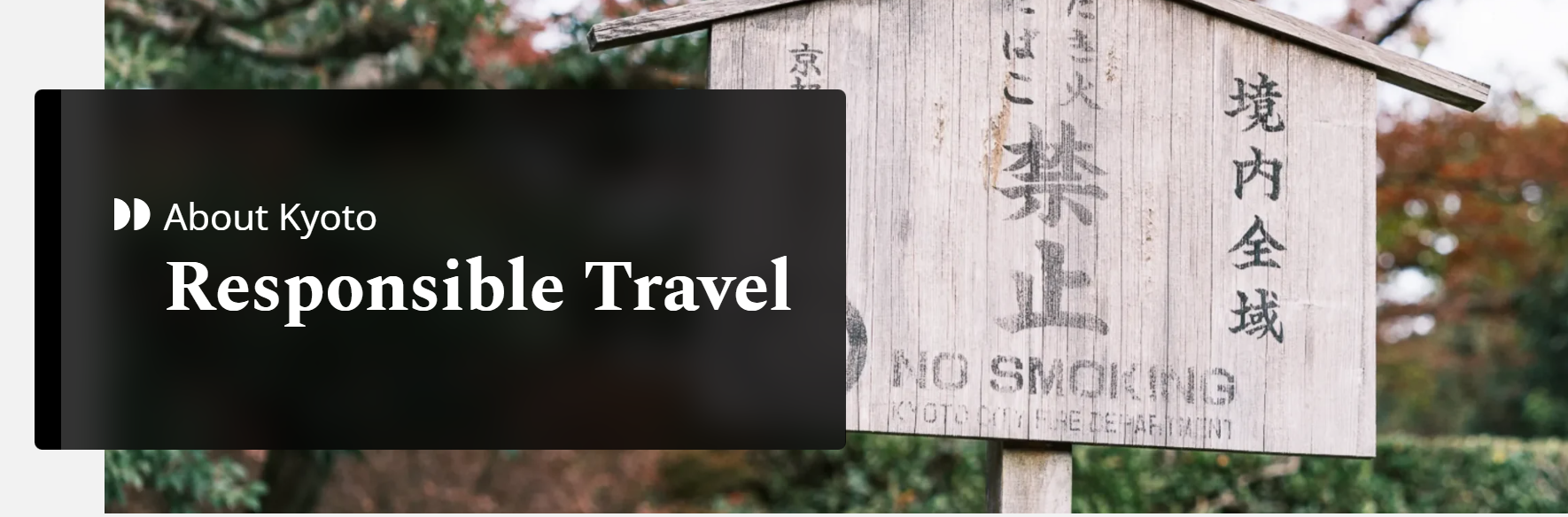
Visitors are further expected to avoid blocking narrow roads, refrain from smoking on public streets, and follow strict anti-littering regulations. To support compliance, Kyoto provides maps indicating the locations of public garbage bins and clearly communicates that fines may apply to inappropriate behavior.
Visitors are asked not to touch historical structures, to remove shoes where required, to carry backpacks in crowded or narrow spaces, and to move quietly through residential and religious areas. Obeying traffic rules and respecting local customs.
2) Encouraging good behavior
– Helpful things you can do
Alongside restrictions, the Kyoto City Tourism Association (DMO KYOTO) actively promotes helpful behaviors.
Luggage-free visits are encouraged. Travelers are advised to use luggage storage services and lockers, allowing for easier movement through the city’s compact streets and transit systems.
Visitors are guided toward more responsible behavior, such as using reusable bottles and shopping bags to reduce plastic disposal. To help with this city provided a list of the establishments’ facilities for free drinking water to refill water bottles.
Visitors are encouraged to use public transportation. They invited having longer stays to find the hidden Gems in the area.
3) Managing Congestion Through Information
-Kyoto Travel Congestion Forecast
Kyoto provides tools to help travelers plan more thoughtfully. The Kyoto Travel Congestion Forecast and platforms like Kyoto Smart Navi offer real-time and predictive information about crowded areas, sightseeing etiquette, and alternative routes or locations.
A Model of Shared Responsibility
Kyoto Travel’s approach demonstrates how destinations can protect living heritage by aligning clear rules, positive guidance, and smart tools. Rather than relying solely on enforcement, the city emphasizes understanding, cooperation, and respect. In doing so, Kyoto shows that responsible tourism is not about limiting access, but about ensuring that cultural and historic places remain vibrant, dignified, and livable for generations to come.
